A managed account-intelligence layer for outbound, inbound, and everything between.
Signals, accounts, content, CRM, outreach, and follow-up connected into one operating system, with automation everywhere it helps and LLM judgment where it matters.
EquipContent librarycase studies, events, sector plays
Account intelligence OSautomation + LLM judgment
ActOutbound timingright account, person, trigger
AdvanceFollow-upnext touch matched to behavior
BriefJuan briefwhy now, why them, what to say
One managed operating layer
AltitudePrepared for Finboot · June 2026
Proposal · Qualified Opportunity Engine
Build the engine. Do not rent the execution.
I believe the advantage is not another outsourced campaign. It is the system you described: a managed intelligence layer, built around Finboot's accounts and content, reading the signals before anyone reaches out, and learning from every result. I build it, operate it, and include the tool stack in my invoice.
Amit Ben Dror, Altitude / For Flavia Sales, Head of Marketing / Built and operated by me
Why this, why now
The problem was never reach. It was readiness.
You have tried agencies, internal and external SDRs, LinkedIn campaigns, Dripify, LeadList. They produced meetings, but the wrong ones. Prospects with no project, no budget, no timeline, sitting at the top of the funnel, burning the CEO's time in a room he should not have been in. Your best clients came from inbound, because inbound qualifies itself. Someone downloads the EUDR guide because they are working the problem right now.
So the goal is not to replicate inbound's volume. It is to replicate its readiness in outbound. With a focused ABM list, the right system is an always-on account watcher: it keeps your named accounts under observation, checks each account on a rhythm, catches the moments that matter, and only asks Juan to move when the account has earned it. Nothing was orchestrated before, and it depended on a person to keep running, so it broke the moment that person got busy or left. This does not depend on a person. It is the engine.
Finboot's own monthly KPI chain
AI GTM Engine deck · forecast 90 days
15-30
intro meetings
->
8-15
qualified meetings
->
3-6
SQL / pipeline
Pilot scope: 30-40 named ABM accounts · buying committee mapped · weekly trigger watch · signal dashboard · expand once the pattern is proven
The shape of it
Three pillars, connected into one engine
This is your own model from the GTM plan, in your terms. ABM decides who. Intent signals decide when. Content decides with what story. The engine is what wires them together.
Who to reach
ABM
Your 30-40 named ABM accounts plus look-alikes. Buying committee mapped per account. Tier 1, 2, 3 by fit.
When to act
Intent signals
Mid and bottom-funnel signals only. Hiring, news, page visits, downloads, CRM. Priority by real timing.
With what story
Content
Your existing sector sequences matched to pain and funnel stage: Mass Balance Chemicals, Biogas, EUDR, CBAM/Steel, First Movers, Events. Same emails and LinkedIn you already use. No new content created.
Right account + right signal + right content = a qualified meeting
The engine
The always-on watcher for your named accounts
Because your ABM universe is small, the engine can go deep. It keeps 30-40 named ABM accounts under active watch, checks each account on a rhythm, refreshes the buying committee, watches for intent and trigger movement, and only escalates when the timing, persona and content fit line up. This is not a broad outbound blast. It is a living account file for every company that matters.
1
Build the account file CRM · ABM list · Apollo · Clay
Start with the named ABM list, clean the CRM history around those accounts, recover missing LinkedIn profiles, and map the real buying committee: supply chain, sustainability, product stewardship, IT and the executive sponsor.
2
Set the watch rhythm weekly refresh + trigger checks
Every account gets checked on a rhythm, with extra checks when a high-value trigger appears. The watcher refreshes people, roles, recent posts, site behavior, content downloads, news, events and competitor research.
3
Read the signal bundle fit · timing · persona · pain
No single signal wins by itself. A content download, a new sustainability portfolio, a relevant LinkedIn move and the right persona together mean something. The engine reads the bundle the way Flavia would read it manually.
4
Match the playbook your existing sequences
The account routes to the right motion before anything sends: Mass Balance Chemicals, Biogas, EUDR, CBAM/Steel, First Movers, or Events. Same content you already have. The engine decides which story fits the account's current moment.
5
Act below the threshold nurture, not meetings
If the account is interesting but not ready, it stays in nurture. Smartlead and LinkedIn run the matched sequence, webinar invites, case studies and follow-ups. Every touch becomes another signal, not another premature meeting.
6
Escalate above the threshold Juan-ready brief
When the score crosses the reliability gate, Juan gets a short brief: why now, who matters, what changed, the matched opening line and the source trail. That is the only moment a human sales touch is worth his time.
7
Feed the result back CRM · transcript · dashboard
Replies, meetings, transcripts and no-responses update the account file. Next week's priority list reflects what actually moved, so the watcher gets smarter instead of resetting every Monday.
SCORE ≥ 90% reliability → the fork
Over 90% · ready
Juan reaches out directly
Lands on the CEO's desk with the why-now, the buying path, and the opening line from the matched playbook. Call, email, or LinkedIn from his account. SABIC case study for a chemicals account. EUDR playbook invite for a palm-oil signal. Event angle when he was at the same conference. The only time Finboot touches a prospect in person, and now it is worth his time.
Below 90% · not yet
Your sequence, on autopilot
Stays with marketing on the vertical track the engine picked. Mass Balance: ISCC and PoS pain, then SABIC, then MARCO. EUDR: countdown mail, then the 5-step playbook, then supplier portal. CBAM/Steel: emissions reporting, then the ebook, then last call. Events: pre-event intro, post-event follow-up, webinar recording. Same copy you already wrote. Each touch is another signal until the score crosses the line.
Even a hand-raise, a form fill, the highest signal you have, gets scored and content-matched before it becomes a meeting. An EUDR guide download still routes through the EUDR sequence first unless the score and timing prove ready. If the answers are not there, it stays in nurture, transparently, not a call with the CEO.
What the engine watches
The signals, and what each one means
We define these together in onboarding, because some of them only you know. Each signal also routes toward a playbook. The point is never one signal. It is the orchestration of several into a read you can trust, then into the right sequence.
Internal · highest weight
Content downloads, read by stage
Which asset, not just that they downloaded. EUDR playbook or guide → EUDR sequence. Mass balance or ISCC content → Chemicals sequence. CBAM ebook → Steel sequence. Regulation piece = early step; implementation guide = mid; case study request = late.
Internal
Form fills and inbound
A hand-raise, the strongest signal you get. Scored and matched to vertical before anyone books. Qualified by conversation if needed, never auto-booked straight to Juan.
External
LinkedIn activity
New connections in the space, joining a relevant group, following the topic, the buying committee getting active. Feeds the LinkedIn touch in whichever email sequence is live for that account.
External · high weight
Competitor-page visits
Visits to Circulor or Circularise read as active evaluation. Bumps score and moves the account to a later step in the matched playbook, not a generic blast.
External
Press and new portfolio
A release announcing a new sustainability portfolio is a target moment. Chemicals press → Mass Balance angle. First Movers or coalition news → Davos decarbonization sequence. They are building exactly the thing that needs what you sell.
External
Events
Panelists, attendees, sponsor lists fed into sourcing. When Juan is attending, the Event sequence runs: pre-event intro, post-event follow-up, webinar recording. Same motion you use today, triggered by calendar and fit.
Fit and timing checks
Revenue and moment
Enterprise revenue confirmed, so the budget is plausible. Sector fit picks the playbook: chemicals, biogas, steel, commodities. A facility closing or bad quarter means hold, wrong moment to advance the sequence.
Generated signal
Webinar and demo behaviour
The weekly webinar is itself a signal generator. Who attends, what they ask, the transcript. One of five attendees may cross 90% for Juan; the other four stay on nurture step three of their vertical track or the event follow-up mail with the recording link.
Worked example · account dossier
One account, read the way the engine reads every account
You asked for proof of depth, not a pretty ABM slide. This is the shape of a live account file: why the account matters, what changed, what the watcher sees this week, who is in the buying room, and what happens next. I am using Braskem because mass balance and ISCC PLUS are its daily reality, which sits right on Finboot's strongest chemicals motion.
Account file
B
Braskem
Petrochemicals · bio-based & recycled resins · mass balance · ISCC PLUS
Braskem is the Americas' largest producer of thermoplastic resins and the world's leading biopolymer maker. Its "I'm green" bio-based PE and "Wenew" recycled portfolio are sold on a sustainability promise that has to be provable down the chain.
Why it is a textbook account for Finboot: mass balance and ISCC PLUS are operations, not theory. Every recycled or bio ton is a claim that needs a verifiable evidence trail. That is the problem MARCO Track & Trace is built to solve.
What changed
The watcher is looking for moments like this
This is the operating point. The engine does not wait for someone to remember Braskem next month. It keeps the account warm and notices when the market, people or proof burden changes enough to justify action.
New owners, new C-suite, June 8-9 2026. Novonor's stake moved to IG4 Capital, which now jointly controls Braskem with Petrobras. An EGM installed an entirely new board and an eight-person executive team, including a newly created Chief Transformation Officer seat. A turnaround mandate with a clock on it is the cleanest buying window there is, and most CRMs still show the departed CEO and CFO. Source: SEC 6-K, June 9 2026 + Braskem leadership announcement
Full renewable and circular ecosystem at K Fair 2025, Oct 2025. Braskem presented its "I'm green" and Wenew lines together under an explicit "supply chain responsibility" message. A growing recycled and bio catalog sold on mass balance is exactly when chain-of-custody evidence becomes a need, not a nicety. Source: Braskem K Fair 2025 release
Bio-based grades moving into regulated segments, interpack Apr 2026. First sugarcane-derived plastics for food-contact and healthcare, including Medcol V7040 for blow-fill-seal pharma. Regulated end-uses raise the bar on documented claims and feedstock traceability. Source: BusinessWire / Braskem interpack 2026 release
ISCC PLUS mass-balance certification, live, Schkopau Feb 2025. Braskem Europe's PP plant holds a current ISCC PLUS chain-of-custody certificate. ISCC PLUS is the literal use case for traceability and evidence software. Source: ISCC PLUS Schkopau certificate PDF
The decision map
Who actually decides, mapped
A traceability-software decision at Braskem is not one person. It spans sustainability, product stewardship, circular economy, IT and data, with a transformation sponsor over the top. The page keeps the read simple; the full map opens when Flavia wants to inspect the room.
The buying path in six: Luiz Rossato (Chief Transformation Officer) sponsors it; Antonio Queiroz, who owns both the bio/recycled roadmap and product stewardship, and Claudia Arruda, who owns polyethylene and circular economy in South America, carry the business case; Carrie Barvinchak (product stewardship) is the technical champion who lives the mass-balance burden; Alessandro Tomazela (CIO) clears the SAP and architecture gate; and Rafael Gusmão (data governance) owns the evidence of record.
Thirty-five people mapped across three tiers. Tier 1 is the new statutory board filed with the SEC at the June 8 2026 EGM; most commercial databases still list the departed CEO and CFO, and the engine flags exactly that kind of change as a buying-window signal. Tiers 2-3 are from Apollo with fifteen LinkedIn profiles individually verified; "enrichment pending" marks records where a public surname was not confirmed, left unmatched rather than guessed.
The newly created transformation seat, installed by IG4 in the June reorg. Ex-Atvos and Via; his mandate is operational efficiency and digital transformation under a turnaround owner, with a clock running.
Way in He owns "transform the company," fast. Tie traceability and evidence to two of his explicit early priorities, efficiency and de-risking, and frame it as low-capex, fast-proof infrastructure for the circular and recycled claims Braskem already monetizes.
Antonio Queiroz Owns the roadmap
VP, Innovation & New Sustainable Businesses · LinkedIn ↗
Both Sustainable Development and Product Stewardship report into his VP, so he is the single executive who owns the bio and recycled product roadmap and the compliance and claims function behind it.
Way in He is scaling toward a one-million-ton biopolymer target by 2030. Every ton sold as "I'm green" or "Wenew" needs defensible chain-of-custody. Position Finboot as the evidence layer that lets him scale claims without scaling audit risk.
Runs product regulatory and stewardship across PP, PE, renewables and recycling globally, with Clarissa Martins alongside her in South America. They live the documentation burden every day.
Way in Lead with the literal pain: managing mass-balance accounting and certificate evidence across sites. Offer a working session on the Schkopau ISCC PLUS workflow as the proof case.
Claudia Arruda Business owner
Polyethylene & Circular Economy Director, South America · LinkedIn ↗
Owns the South America polyethylene and circular-economy business line, where recycled-content sourcing, demand creation and product claims meet revenue.
Way in Recycled content is only sellable if its provenance is provable. Position traceability as what turns circular-economy volume into premium, claim-backed product, tied to revenue, not just compliance.
Alessandro Tomazela Tech gate
Global IT Director (CIO) · LinkedIn ↗ with Marcos Pavlick Abech, CTAO
Tomazela owns global IT and ERP strategy; Abech owns the SAP S/4HANA clean-core and data roadmap. Any traceability platform has to sit cleanly on their stack.
Way in Engage early on architecture fit, framing Finboot as a thin evidence layer over existing SAP master data, not another silo, so they sponsor it rather than block it.
Owns data governance and reporting, the system of record that sustainability claims must reconcile against, and the person who has to defend the numbers in the integrated report.
Way in Offer audit-grade, reconcilable evidence trails as a way to cut his reporting risk and manual reconciliation load.
The engine, on this account
How Braskem becomes a qualified meeting
The account file is the input. This is what the always-on account watcher does with it, the same loop it runs on each named ABM account, so Juan only sees the ones that have earned the call.
1 · Refresh
Keep the account file current
The watcher refreshes Braskem on schedule, so the record reflects the June 2026 leadership, not the stale CEO and CFO most databases still show.
2 · Detect
Notice the account-specific triggers
It watches what matters here: ISCC PLUS renewals, K and interpack launches, recycled-content and food-contact press, the new transformation agenda, and job changes on the committee.
3 · Interpret
Read signals against the buying path
A stewardship trigger touching Barvinchak or Queiroz counts for far more than generic company news, because those people carry the product-proof burden.
4 · Route
Assign the right Finboot story
Braskem routes to your Mass Balance Chemicals playbook, not EUDR or CBAM. Barvinchak gets the ISCC and PoS angle; Queiroz gets the SABIC scale story; Rossato gets efficiency and de-risking on claims they already monetize.
5 · Decide
Nurture or escalate
If the read is strong but not ready, the sequence continues. When the same account crosses the reliability gate with Rossato and Queiroz in the read, Juan gets a brief with the Schkopau ISCC proof case and your existing LinkedIn opener on mass balance certification schemes.
6 · Learn
Write the result back
Opens, replies and call transcripts update CRM and Supabase. A working-session request bumps score; a no-reply after email three holds the account in nurture. Next week's priority list reflects what actually moved.
The angle, in one line
Make every "I'm green" and Wenew ton provable, the evidence layer behind claims Braskem already sells
Braskem already monetizes bio and recycled volumes on a sustainability promise, runs mass balance and ISCC PLUS daily, and just put a transformation-mandated leadership in charge. Finboot is the layer that makes those claims auditable, sales-ready and defensible. The engine finds the moment, scores the people, and only puts it in front of Juan when it is real.
This dossier is one account. The engine produces this for the full ABM set and keeps it live as triggers and people change, which, as Braskem just showed, they do.
Source-backed read
Every claim stays traceable
This is how the watcher should work on the real ABM list: public facts get cited, enrichment gets marked, and anything unverified stays out of the recommendation until it is checked.
Verified public sources
SEC 6-K, June 2026: new board, statutory officers and Chief Transformation Officer.
Apollo plus individually verified LinkedIn profiles for functional owners and reporting lines, marked as enrichment rather than public fact.
Recent LinkedIn activity, job changes, posts and connection movement, verified before any outreach recommendation.
Website de-anonymization, content downloads, webinar attendance and CRM history, only from Finboot-owned systems.
Competitor-page visits only when observed in the tool stack, never invented for a proposal example.
The point is the operating model: verified public facts first, enrichment second, then periodic watching, scoring and outreach only when the account has earned it. No guessed LinkedIn URLs, no invented intent, no stale sources passed off as signal.
The stack I run for you
A managed stack, tuned by results
You said it plainly: you do not want to manage tools. So the stack runs on my side, under my subscriptions and operating accounts, and my monthly invoice includes the software layer. The tool names below are the starting stack, not a rigid promise that we never change. We keep testing the routes, sources and channels, then keep what gets the best signal quality and meeting quality for Finboot.
Sourcing & enrichment
find and complete the right people
Clay + Apollo to start
Clay orchestrates the lookups and waterfalls, Apollo supplies the contact and firmographic base. If another source gives cleaner committee coverage or lower bounce risk, we swap it in. The measure is not tool loyalty; it is better account files.
Intent & signals
know when, not just who
Common Room + website de-anonymization (RB2B) to start
Common Room unifies signals across LinkedIn, CRM and downloads. The de-anon layer tests which companies are visiting your site and competitor comparisons. We keep the signals that predict replies and qualified meetings, and drop noisy ones.
Watcher and scoring
the intelligence layer, the core
Claude + Supabase on my managed stack
This is the part you cannot buy off a shelf. Claude reads each account file and trigger bundle the way you do manually today. Supabase holds the account state, scores, workflows and history. I operate this layer and report what it is doing.
Outreach
the over-90%, from the right account
Smartlead + Extrovert to start
Below 90%, your existing sector sequences run on the matched vertical track. At 90%+, Juan's first touch can be email, LinkedIn, or a prepared call brief. We test channel mix by replies, meeting quality and speed to opportunity.
Nurture & content
everyone not yet ready
Same rails + your existing content library
No new content. Your six sector and event sequences (Mass Balance, Biogas, EUDR, CBAM/Steel, First Movers, Events) run on Smartlead and Extrovert, matched by account vertical and signal. Webinars, PDFs, case study links, and agenda CTAs exactly as you wrote them.
CRM sync & reporting
transparent outcomes
Your CRM + managed dashboard
Qualified activity and next steps write back to your CRM where needed. The operating dashboard lives in the managed stack and shows what was watched, reached, opened, scored, surfaced and learned.
Note: I have assumed your CRM stays as is. If it is HubSpot, Salesforce or Pipedrive, the sync adapts to it. The tool picks above are the starting configuration; the operating principle is test, measure, keep what works, and remove what does not.
Operating model
You do not manage tools. You manage decisions.
This is the cleanest version of the managed-service model: I carry the stack, the subscriptions, the monitoring, the debugging and the weekly optimization. Finboot gives access to the CRM, content, account list and strategic decisions. My invoice includes the tool layer, so you do not have to open accounts, manage subscriptions or become the operator.
The system is still not a black box. You see the account watchlist, the signals, the scoring logic, the outreach status, the meetings surfaced and the changes made week by week. The strategic calls stay inside Finboot, or we make them together: which accounts, what counts as qualified, the verticals, the budget, the priority. External stack, external execution, transparent decisions.
Build
Weeks 1 to 3
I build to first live operation
GTM architecture
Managed stack setup
Scoring and signals
Workflows and dashboard
Base sequences live
Operate
Months 1 to 3
I execute, you decide
Campaigns live
Social selling
Optimization
Transcript analysis
Weekly reporting
Maintain & scale
From month 4
I keep operating and tuning
New verticals
Playbook improvements
Tool tests
Signal calibration
Optional PR and ads
Close to your world
Two I have built like this
Both are the same idea you are buying: an intelligence layer that reads accounts and signals so a small team only spends time where it counts. I work with two or three clients at a time, custom-built for each, so I am there when you need me.
High-trust outbound infrastructure
Cobalt
A case-study build for a complex, high-trust B2B category: account research, buyer context, proof points and outreach logic packaged so the team could understand why each account was worth touching before the first message went out.
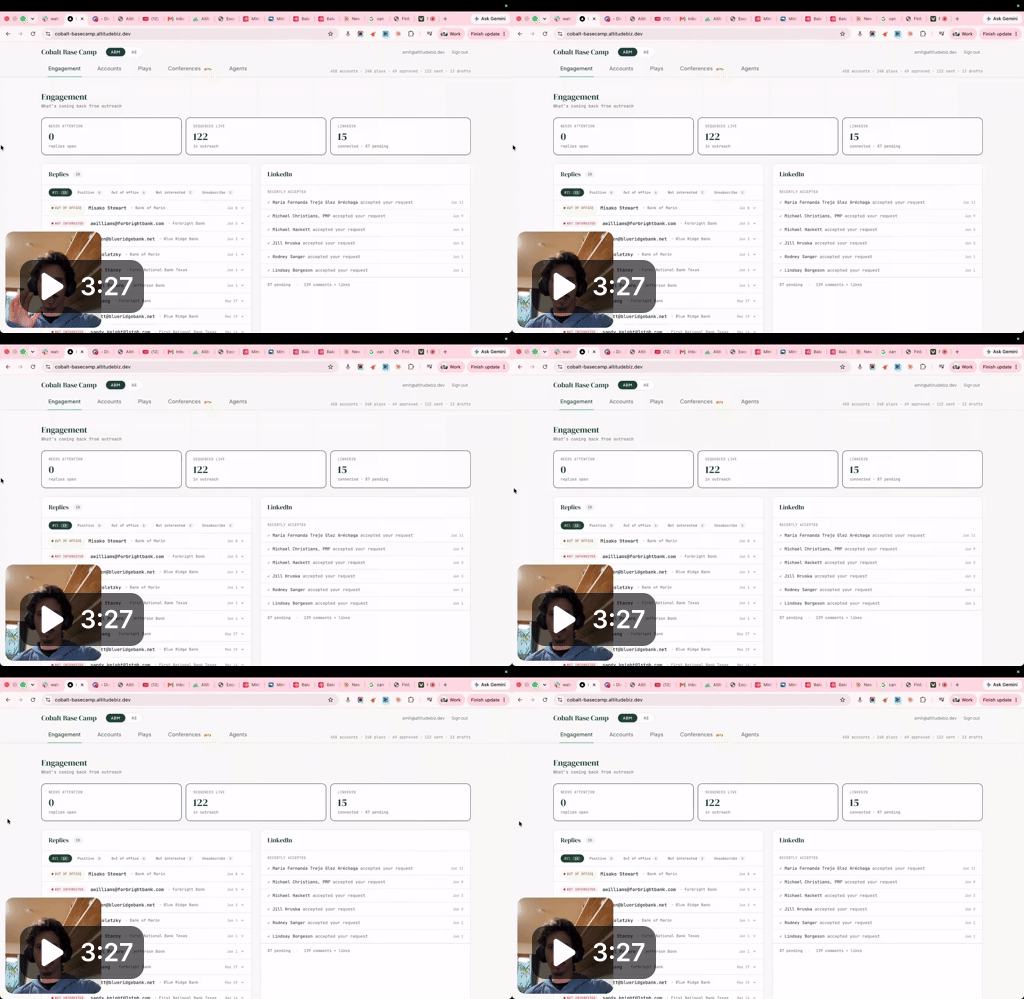
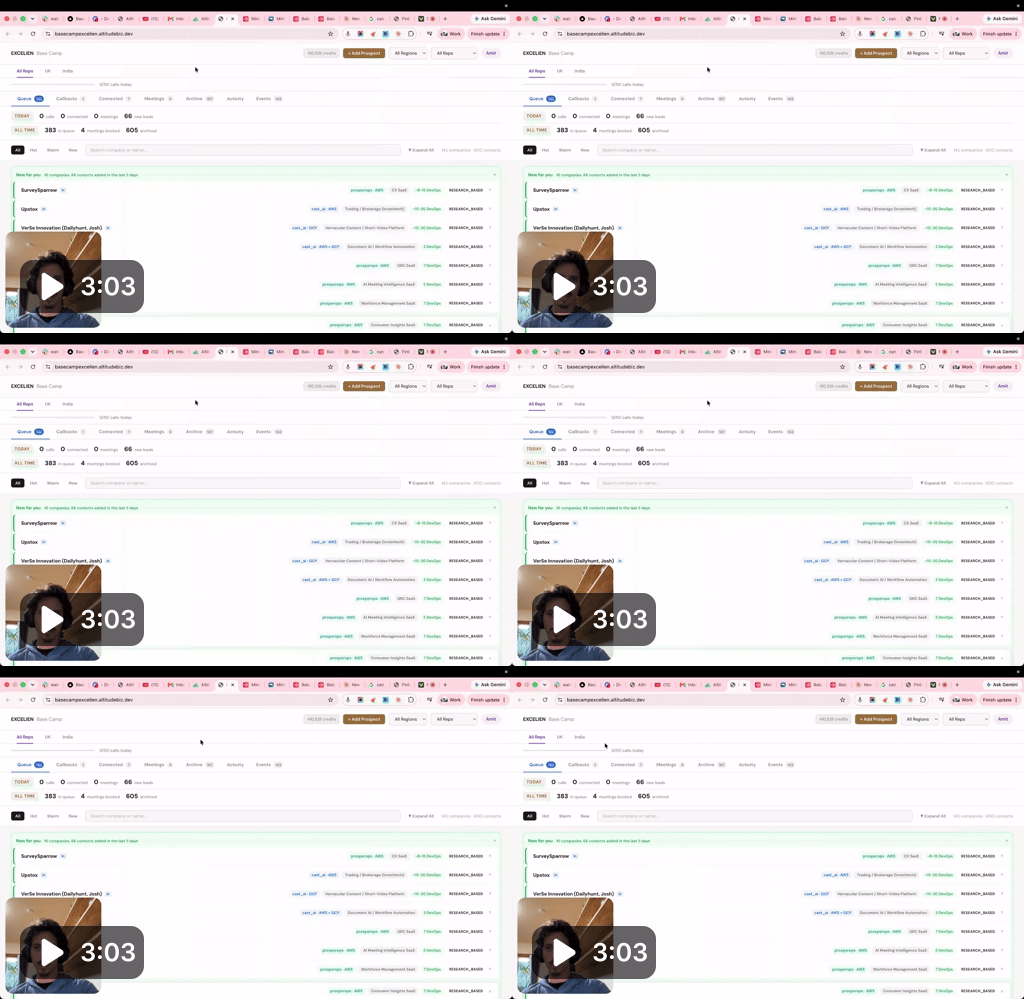
A triggers and intelligence layer sitting on top of a sales team. It researches accounts, watches for the signals that make outreach relevant now, and surfaces signal-backed leads to the reps. The system booked its first qualified meeting in week 1.
Full-service and all-in: I build the stack, operate it, pay for the tools and keep optimizing. The first engagement can be treated as a 3-month pilot: three weeks to first live operation, then enough live running time to see which signals, accounts and channels produce the best meetings. They pay nothing more, manage nothing more, and have Amit on speed dial.
3-month pilot
$12,000
$4,000/month x 3, tools included
Build the managed stack, connect the core workflows, launch the watcher within three weeks, then operate and tune it through the pilot.
Maintenance after pilot
$2,000
per month after month 3
Keep the watcher live, refresh account intelligence, tune signals, maintain workflows, and stay available when the team needs the operator.
The one thing to align early
The meeting target is ambitious: 15-30 intro meetings, 8-15 qualified meetings and 3-6 SQL / pipeline opportunities per month. The outreach tone should still stay non-aggressive. Those can work together if the engine increases signal discipline rather than pressure: fewer cold guesses, better timing, stronger account context, and outreach only when the account has earned it. That is the calibration I would make with you in the pilot.
In short
The vision is already yours. I build and run it.
You walked into the call knowing exactly what you wanted, an intelligence layer that scores on signals and only acts at over 90%. That is the thing I build. This proposal is the managed engine, made real around your ABM list and content, with one account read end to end so you can see how it thinks. Three weeks to first live operation, qualified meetings inside the quarter, and a stack you do not have to manage.
Happy to walk through it live before your Tuesday review with Juan, and to reshape the scope on the call. Whatever you need, I am here for it.